
International Pompe Association | Update
Source note: This update is based on information provided by Sanofi during a discussion with the International Pompe Association (IPA) on August 7, 2026, together with publicly accessible regulatory and medicines-supply documents. Sanofi’s operational account is identified as such where it has not been independently verified by the IPA.
In brief
- Sanofi says the current constraint is not a shortage of active pharmaceutical substance (the drug), but a bottleneck in final manufacturing, quality-control and batch-release processes at Waterford.
- The FDA inspected Genzyme Ireland Limited in Waterford on January 12–20, 2026, and issued a Form FDA 483 that listed core findings, followed up by Warning Letter CBER 26-728681 on June 22, 2026.
- EMA product information identifies the Waterford site as responsible for batch release for Myozyme and Nexviadyme, linking the site directly to European Pompe medicine supply.
- Supply conditions differ substantially between countries. A shipment to one market does not mean that global supply has returned to normal. It’s normal for countries to be at different points in their supply cycle at any given time.
- Sanofi decides how available product is distributed between countries, but they do get input from treating physicians that helps them distribute the limited supply; treating physicians decide how medicine available locally is used for individual patients.
- Important questions remain unanswered, including country-level release quantities, allocation criteria and how much advance warning treatment centres can expect before supply changes.
- Sanofi has not given a firm date for full recovery. Restoring deliveries comes before rebuilding the safety stocks needed for a resilient supply chain.
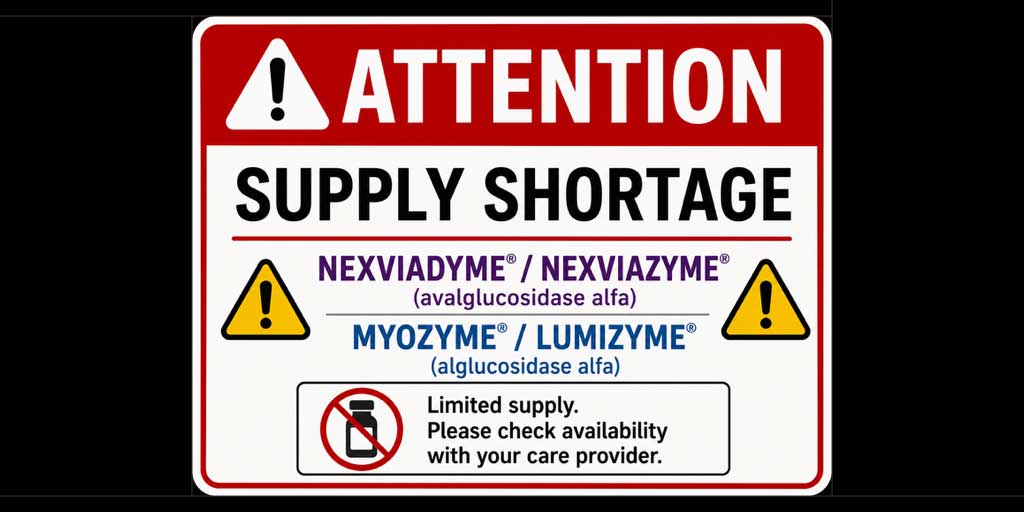
Supply constraints affecting Sanofi’s Pompe disease treatments Myozyme®/Lumizyme® (alglucosidase alfa) and Nexviadyme®/Nexviazyme® (avalglucosidase alfa) are expected to continue to affect patients in different parts of the world. According to information provided by Sanofi in a discussion with the International Pompe Association (IPA) on August 7, 2026, the underlying problem is not a shortage of active pharmaceutical substance, but a bottleneck in the final manufacturing, quality-control and release processes at the company’s Waterford site in Ireland. The impact varies considerably between countries. Some markets have already experienced severe shortages, while others still have stocks available. Countries may therefore be affected at different times depending on existing inventories, previous deliveries, patient numbers and local distribution systems. Sanofi has not provided a firm date for a return to normal global supply. The company expects the recovery to take time and has indicated that it could take months before the situation is fully stabilised. Even when the flow of newly released product improves, rebuilding normal safety stocks will take longer.
What caused the shortage?
The following explanation of the immediate supply bottleneck is based on information provided by Sanofi to the IPA on August 7, 2026.
According to Sanofi, there is sufficient active pharmaceutical substance (drug) available to supply the global market, and the bottleneck occurs later in the manufacturing chain. Sanofi states that the biological drug substance must undergo further processing before it becomes a finished medicinal product that can be supplied to hospitals and patients, and that the Waterford facility plays an important role in these later stages, including final processing, fill and finish, quality control, documentation, packaging and release activities. The FDA inspected Genzyme Ireland Limited in Waterford from January 12 to January 20, 2026 and issued a Form FDA 483 that listed core findings. On June 22, 2026, the FDA issued Warning Letter CBER 26-728681, citing significant current good manufacturing practice (CGMP) deficiencies in the site’s quality systems and documentation. The Warning Letter specifically names Thymoglobulin and Altuviiio, two medicines unrelated to Pompe disease. The relevance of Waterford to Pompe medicines is independently documented in regulatory product information. The European Medicines Agency (EMA) product information, Annex II, identifies Genzyme Ireland Limited, Waterford, as a manufacturer responsible for batch release for Myozyme and Nexviadyme. This provides the regulatory link between the Waterford site and the European supply of these Pompe therapies. The significance of the Warning Letter can therefore extend beyond the two products explicitly named. The FDA’s findings concern systems and processes at the Waterford facility, particularly the site’s quality oversight. However, the IPA does not infer from the Warning Letter alone that it caused every supply constraint observed in individual markets. Sanofi states that it has introduced additional quality-control and verification steps in response to the regulatory findings. According to Sanofi, these measures (approved by the FDA) are intended to ensure that manufacturing procedures and their documentation meet the required standards, but they also take additional time. Sanofi further states that, as a result, product is moving more slowly through the Waterford facility and that sufficient drug substance cannot currently be converted into released finished product quickly enough to meet global demand.
Timeline and what is known
The FDA inspection took place from January 12 to January 20, 2026, and issued a Form FDA 483 that listed the core findings. The Warning Letter was issued on June 22, 2026 (CBER 26-728681). Public shortage information does not appear everywhere at the same time. The IPA is continuing to review the timing and development of supply constraints in individual countries as further public information becomes available. These dates should not be read as proof that the FDA findings caused every national shortage. Supply conditions may have different local histories and contributing factors.
Does the shortage mean there is a quality problem with the medicines?
According to Sanofi, no. The company stressed that medicines currently being released from Waterford meet the required specifications for quality, safety, purity and other relevant product characteristics. The present supply problem does not mean that released Myozyme/Lumizyme or Nexviadyme/Nexviazyme is unsafe or defective. The regulatory issue concerns the manufacturing quality system, including documentation and process controls. In pharmaceutical manufacturing, it is not sufficient for a process simply to be performed correctly. The manufacturer must also be able to demonstrate through complete documentation that required procedures have been followed.
Corrective and preventive measures, often referred to as CAPAs, can involve changes to procedures, additional controls, staff training, documentation and continued exchanges with regulators.
Why does an FDA Warning Letter affect patients outside the United States? The FDA is the US regulator, but the effects of its findings do not necessarily stop at the US border because Waterford is part of an international manufacturing and supply chain. Products processed at the site are destined for multiple markets. If additional quality controls slow down a shared manufacturing or release process, products intended for countries outside the United States can also be delayed. According to Sanofi, quality measures arising from the findings are being applied across relevant operations at the site rather than through separate standards for US-bound medicines and medicines intended for other countries. The FDA has therefore not stopped other countries from receiving Pompe medicines. Rather, according to Sanofi’s account, measures taken at a manufacturing site serving multiple markets have reduced the speed at which finished product can be released into the global supply chain. Regulatory authorities also exchange information internationally. Findings by a major regulator such as the FDA can therefore be relevant to other national and regional authorities assessing medicines manufactured at the same facility.
Why are some countries affected earlier than others?
The disruption does not mean that every country runs out of medicine at the same time. Medicines are held at different points in the supply chain, and national distributors, hospitals, pharmacies and treatment centres may have different levels of stock. Countries also differ in patient numbers and monthly demand. A country with larger remaining inventories may therefore continue treating patients normally for some time, while another market may already have very limited supplies. Countries that currently appear unaffected could experience constraints later if the manufacturing backlog is not resolved quickly enough, or they may ultimately be unaffected. Sanofi has described the situation as highly dynamic, with available quantities and shipment plans changing as new batches pass through the required processes. For this reason, the company has so far been reluctant to provide public country-by-country delivery dates that may subsequently change.
What is being done?
Sanofi says it is working to increase throughput at the Waterford facility while maintaining the additional quality controls required to address the regulatory findings. Additional resources are being devoted to quality systems, documentation, process improvements and regulatory remediation. Sanofi is also allocating available finished product across countries and patient populations. Allocation between countries is a manufacturer decision, with input from treating physicians. The criteria used for these country-level allocation decisions have not been made public to the IPA. Patient organisations are not part of manufacturer allocation decisions and do not take part in decisions about the treatment of individual patients. Another option is the temporary use of packs originally intended for a different market, an approach already used during the current shortage. Whether such redistribution is possible depends on national regulatory authorities.
A medicine intended for another country may have different packaging, labels and patient information. Some regulators can temporarily authorise such packs during a shortage, while others may require relabelling or additional documentation. This authorization can take some time, so is often not a reasonable option. These requirements can determine how quickly existing stocks can be redirected.
What was asked and remains unanswered?
During the August 7 discussion, the IPA asked for greater operational clarity on how the shortage will develop and what treatment centres can realistically plan for. Sanofi did not provide firm answers to several points that remain important for patients and healthcare teams.
- Expected release and delivery quantities: no reliable country-by-country figures were provided for the amounts expected to become available, including quantities expressed in terms that would allow patient need to be compared with supply.
- Advance warning: there was no firm commitment on how much notice treatment centres, clinicians or patient communities can expect if a country’s supply situation is likely to deteriorate or a planned delivery changes.
- Recovery milestones: no firm timetable was provided for when manufacturing throughput is expected to return to a level that covers ongoing demand, or when depleted safety stocks can realistically be rebuilt.
These open points matter because a global statement that production is continuing does not by itself allow treatment centres to plan individual infusions. The IPA considers more predictable, country-relevant information essential while supply remains constrained.
Managing limited supplies
Two different levels of responsibility need to be distinguished. Decisions about how much product is distributed to a country are made by the manufacturer. Decisions about how medicine already available within a country is used for an individual patient are clinical decisions for treating physicians and the relevant medical teams. Where supplies become critically low, physicians may have to consider how the medicine available to them can be used most safely and effectively, taking account of the individual clinical situation. Sanofi remind us that such individual treatment decisions should be made by treating physicians and relevant medical experts rather than by the manufacturer. Alternative approved Pompe therapies may be an option for some patients, but their availability, regulatory approval, reimbursement and access differ substantially between countries. Any change of therapy is a medical decision and should not be regarded simply as a logistical response to a temporary supply problem. Patients should therefore discuss any proposed change in dose, infusion schedule or therapy with their Pompe specialist and should not make changes to treatment on their own.
Recovery will not happen everywhere at once
New batches continue to move through the manufacturing and release process, but at a reduced rate. The present shortage should therefore not be understood as a permanent halt in the production of Sanofi’s Pompe medicines. However, this does not mean that normal supply will return immediately. Individual countries may receive new shipments and see their situation improve, only to face renewed pressure before another shipment arrives, or when other countries have greater need. Such fluctuations are possible while manufacturing throughput and inventories remain below normal levels.
There is also an important difference between restoring deliveries and restoring a resilient supply chain. The first priority is to produce and release enough medicine to meet ongoing patient demand. Only after that can safety stocks throughout the international supply chain be rebuilt. For this reason, a new shipment to a country should not necessarily be interpreted as the end of the shortage.
What the IPA considers essential now
For people living with Pompe disease and their families, uncertainty about the next infusion can itself be a considerable burden. Treatment centres also need timely information if they are to plan infusions and make difficult clinical decisions when supplies are limited. The IPA therefore considers regular and transparent communication essential throughout the shortage. The Pompe community needs to know not only whether production is continuing, but how quickly medicines are becoming available again and how the situation is developing across the global supply chain. This is particularly important for the patients most severely affected. The IPA will continue to seek updated information on the availability of Myozyme/Lumizyme and Nexviadyme/Nexviazyme and will share relevant confirmed developments with the international Pompe community. The current measures provide routes towards recovery, but the situation remains serious. Until manufacturing throughput has stabilised and adequate safety stocks have been rebuilt, patients and treatment centres in different parts of the world may continue to experience supply constraints.
Appendix: Publicly accessible sources
The sources below support the regulatory and product-information elements of this update. Statements attributed to Sanofi about current manufacturing operations, remediation measures, allocation and expected recovery are based on the IPA–Sanofi discussion of August 7, 2026 and are not represented here as independently verified public facts.
- US Food and Drug Administration (FDA) — Genzyme Ireland Limited Warning Letter, CBER 26-728681, June 22, 2026.
https://www.fda.gov/inspections-compliance-enforcement-and-criminal-investigations/warning-letters/genzyme-ireland-limited-728681-06222026 - European Medicines Agency (EMA) — Myozyme EPAR and Product Information. Annex II contains manufacturing and batch-release information.
https://www.ema.europa.eu/en/medicines/human/EPAR/myozyme - European Medicines Agency (EMA) — Nexviadyme EPAR and Product Information. Annex II contains manufacturing and batch-release information.
https://www.ema.europa.eu/en/medicines/human/EPAR/nexviadyme - French National Agency for the Safety of Medicines and Health Products (ANSM) — public medicines-supply information.
https://ansm.sante.fr/ - Belgian Federal Agency for Medicines and Health Products — PharmaStatus, public database for medicine availability in Belgium.
https://pharmastatut.be/